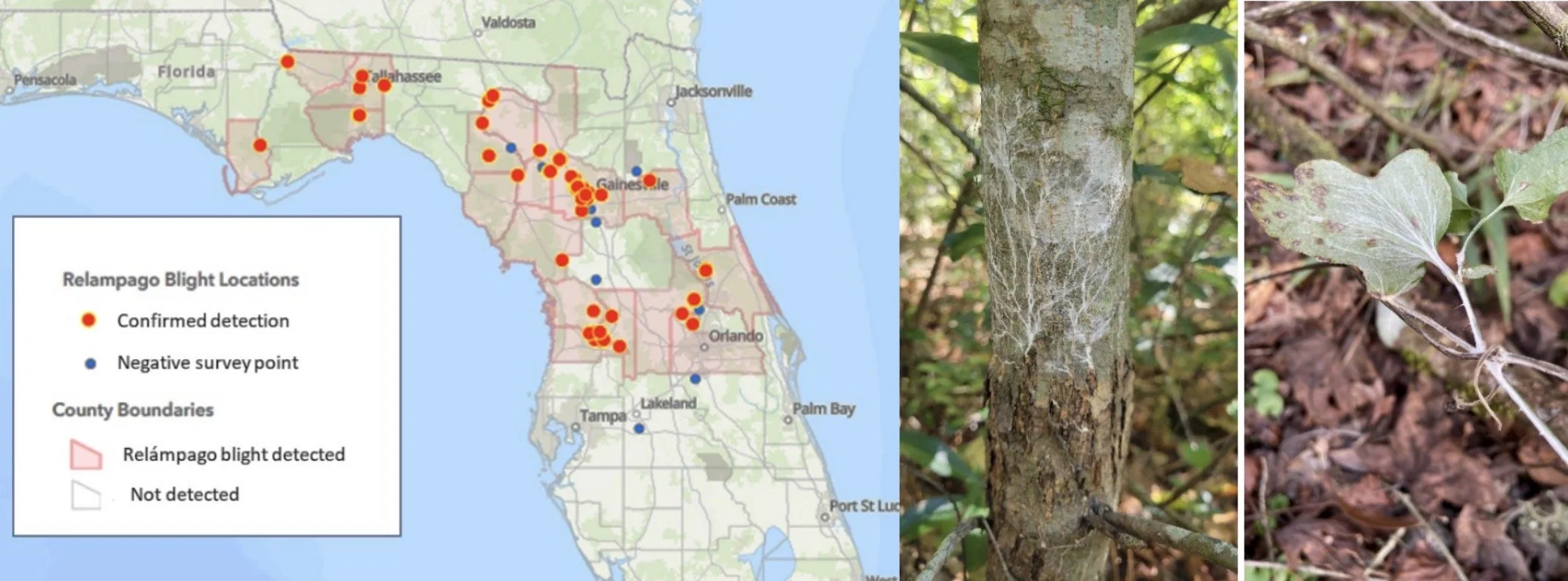
A new pathogen has been making its way through North Central Florida in recent years. Named Relampago Blight for its lightning-bolt appearance (relampago meaning "lightning" in Spanish), this novel fungus is more than just a curiosity—it is a growing concern for our local canopy. First detected in 2019, it has already crept into at least 18 counties (including Alachua), where it has been causing leaf and twig dieback, and even the death of younger trees.
Discovery and DNA: The Race to Identify a New Species
Two scientists at the University of Florida’s Forest Pathology lab, Dr. Jason Smith and Ph.D. student Claudia Paez, have been heading the research into this mysterious pathogen. Through rigorous DNA analyses, they determined that the fungus didn’t match any known species, marking it as a significant new discovery in the field. As more samples arrived at their lab, they mobilized a network of specialists to study the novel pathogen and understand its behavior. Relampago Blight doesn’t seem to favor specific tree species, like most fungal pathogens do. It has been found in an abundance of species, some not closely related at all. Even more worrisome is the fact that it has been found to attack fully healthy, living trees as well as dead or dying ones. Fungi typically don’t show up on a tree unless it is dead, dying, or diseased, but this one has been found on strong individuals.
A Herbivorous Horror
One of the most interesting things about this fungus is that it doesn’t have a preference for any one specific tree or plant. So far, it has been found to infect 27 different woody plants such as the native Sand Laurel Oak (Quercus hemisphaerica), Southern Magnolia (Magnolia grandiflora), the Florida Yew (Taxus floridana), Smilax, and wild Grapevine (Vitis).
https://www.fs.usda.gov/foresthealth/docs/fhh/FL_FHH_2023.pdf
Threat to the Florida Torreya
Even more concerning is what Relampago Blight could mean for the native Florida Torreya tree (Torreya taxifolia), an endangered conifer endemic to the area surrounding the Apalachicola River. This tree is only found in two Florida counties and one Georgia county, and estimates put it at having less than 1,000 individuals left in nature. Efforts are currently underway to bring back this amazing native plant.
Historically the Florida Torreya has been threatened by a canker-causing fungus that has diminished its numbers drastically in the wild, so the addition of a new disease on a limited population has the potential to further reduce this rare tree’s population even further.
How to Help
Currently, the Plant Pathology Lab at UF is studying this fungus and trying to figure out where it comes from and how to manage it.
If you find this fungus on your property or in one of your land management areas you can send images of it to katydeitz@ufl.edu to assist in furthering their research.
Resources & Further Reading
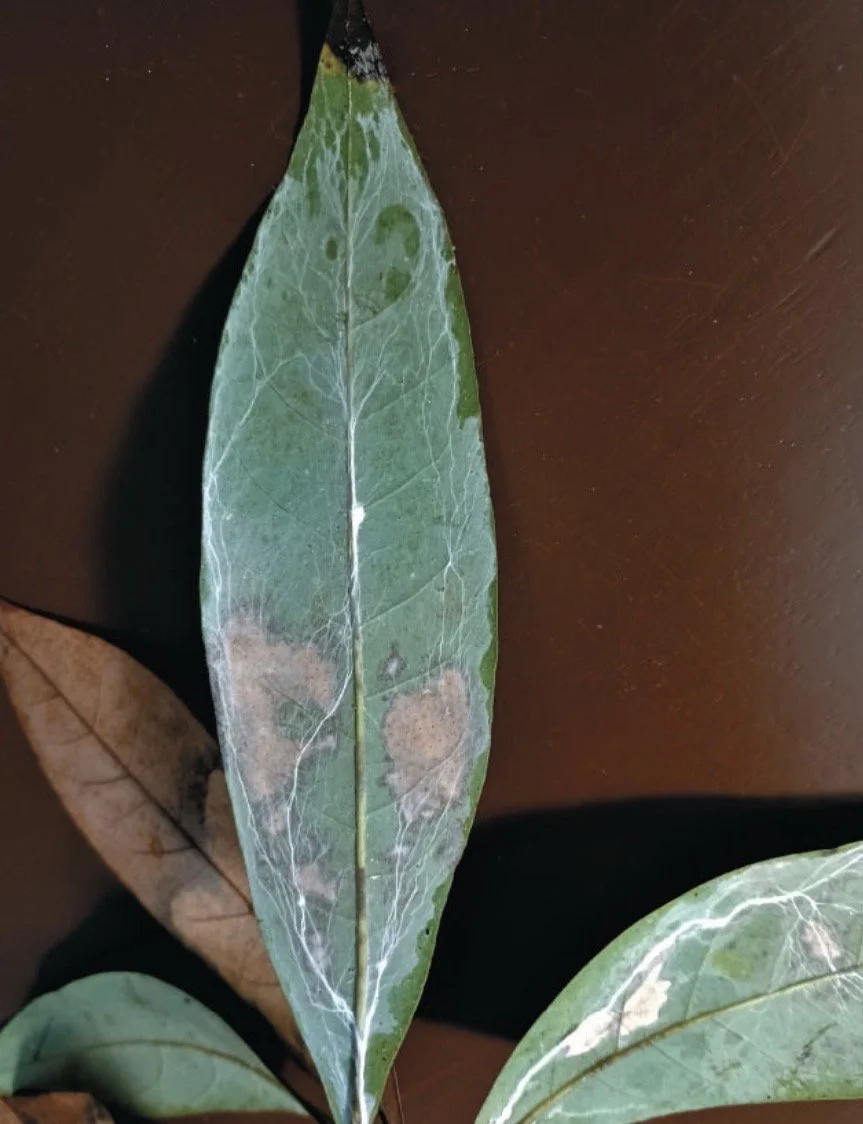
Fungus filaments
Distribution of the fungus in Florida